
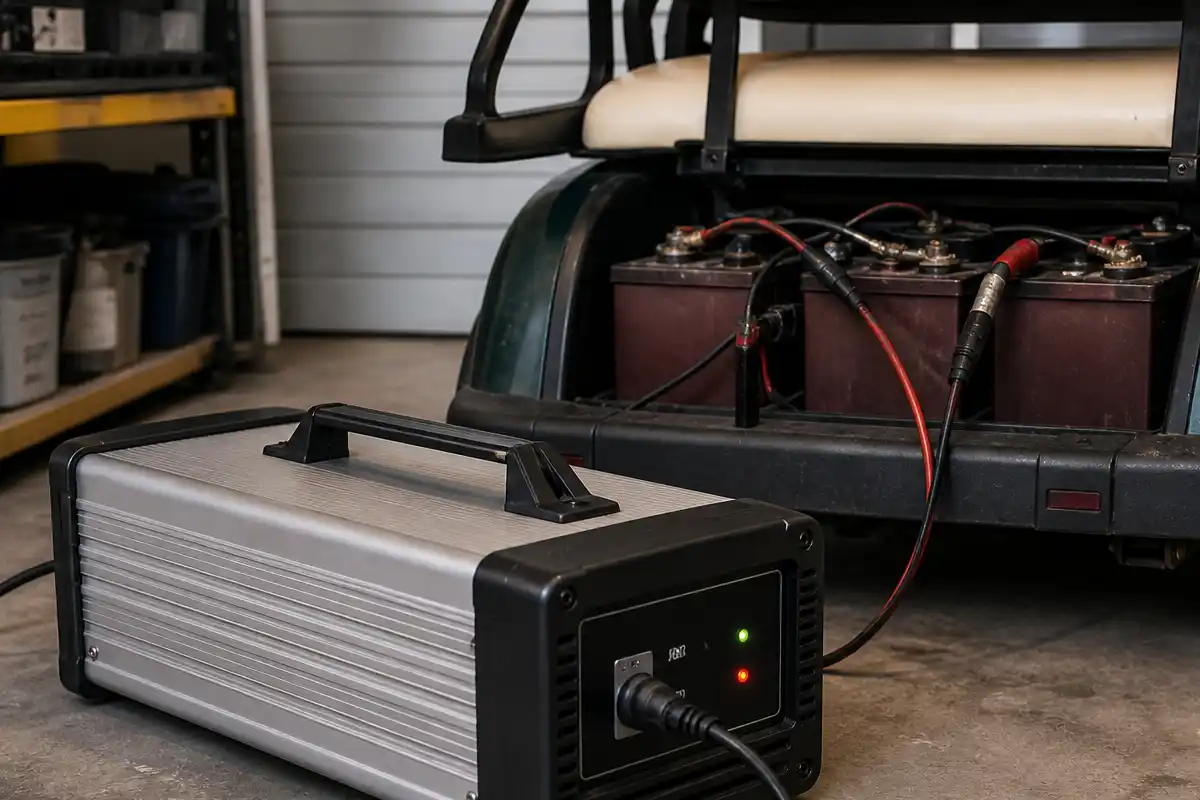
Summary:If your golf cart charger clicks but does not charge, the issue is usually tied to low battery voltage, a relay that cannot fully engage, or a safety lockout built into the charger. Most modern chargers will not activate if the battery pack voltage is too low. In many cases, the clicking sound is the relay attempting to start but failing due to insufficient voltage or poor connections. Fixes often involve checking battery voltage, cleaning terminals, or manually boosting the battery pack to restore proper charging behavior.
A golf cart charger that clicks but refuses to charge is one of those frustrating issues that feels like it should be simple but can quickly turn into a guessing game. You plug it in, hear the click, maybe even see a light flicker, and then nothing happens. No charge, no progress, just silence after that initial attempt.
The good news is that this problem is extremely common, and in most cases, it comes down to a few predictable causes. Once you understand what the clicking actually means, you can narrow things down quickly and get your cart charging again without replacing expensive parts unnecessarily.
What the Clicking Sound Actually Means
That clicking sound you hear is not random. It is coming from a relay inside the charger. Think of the relay as a gatekeeper. When you plug in the charger, the relay tries to close and allow electricity to flow into the battery pack.
If everything checks out, the relay closes fully and charging begins. If something is off, the relay will attempt to engage but then immediately drop out. That is the clicking you hear.
So the clicking itself is not the problem. It is a symptom. It tells you the charger is trying to do its job but something is preventing it from committing to a full charge cycle.
Relay Clicking Without Charging
When the relay clicks but nothing follows, it usually means one of two things. Either the charger is not seeing the correct voltage from the battery pack, or there is resistance somewhere in the system preventing proper current flow.
In older carts, this could be due to worn internal components. In newer smart chargers, it is almost always a protection feature kicking in.
Modern chargers are designed to protect your batteries. If the voltage is too low, the charger assumes something is wrong and refuses to start. This prevents overheating, battery damage, and unsafe charging conditions.
So the relay clicks, checks conditions, and then shuts itself off.
Battery Voltage Lockout Explained
This is the most common cause by far.
Golf cart chargers require a minimum battery pack voltage before they will engage. If your batteries drop below that threshold, the charger will not recognize them as a valid load.
For example, a 48 volt system might need to see at least 36 to 42 volts before the charger will activate. If your batteries are deeply discharged or have been sitting unused for a long time, they may fall below that level.
When that happens, the charger behaves exactly like this:
- You plug it in
- The relay clicks
- The charger shuts off
It is not broken. It is refusing to charge because it thinks the batteries are unsafe or disconnected.
Why Batteries Drop Too Low
There are a few common reasons your battery pack ends up below the activation threshold.
Letting the cart sit for long periods without charging is a big one. Batteries naturally self discharge over time, and if they are not maintained, they can drop into a range where the charger no longer recognizes them.
Another cause is repeated deep discharges. Running your cart until it is completely dead over and over again can permanently reduce battery voltage capacity.
Bad connections can also play a role. Corroded terminals or loose cables can prevent the charger from seeing the true voltage of the pack.
Real World Pro Tip from the Community
There is a consistent takeaway from real users dealing with this exact issue.
On Reddit, one user explained the situation perfectly after dealing with a charger that kept clicking but would not charge. The fix was not replacing the charger at all. It was bringing the battery voltage back up just enough for the charger to recognize it.
“Low pack voltage can prevent the charger from even starting. Once I bumped the voltage up, it worked like normal.”
This lines up with what technicians see every day. The charger is often doing exactly what it is supposed to do. The batteries just are not meeting the minimum requirement to begin charging.
How to Fix It
Now that you know the cause, the fix becomes much more straightforward.
The first step is always to check your total battery pack voltage with a multimeter. This gives you a clear answer on whether you are dealing with a low voltage lockout.
If the voltage is too low, you have a few options.
One approach is to use a standard battery charger to individually charge each battery in the pack for a short period. This raises the overall voltage enough for the main charger to recognize the system again.
Another method is to use a compatible charger with a manual override or low voltage recovery mode, if available.
You should also inspect all battery terminals. Clean off corrosion, tighten connections, and make sure there are no damaged cables. Even small resistance issues can interfere with proper voltage detection.
If your voltage is normal but the charger still clicks, then you may be dealing with a faulty relay, a damaged charger board, or a bad connection in the charging port.
When It Is Not the Batteries
While low voltage is the most common issue, it is not the only one.
A worn relay inside the charger can cause repeated clicking without engagement. Over time, these components degrade and lose the ability to stay closed under load.
The charging receptacle on the cart itself can also cause problems. Loose or worn contacts can interrupt the connection just enough to prevent charging.
In rare cases, the onboard computer or controller may interfere with charging if it detects a fault elsewhere in the system.
Preventing This Problem in the Future
The easiest way to avoid this situation is consistent battery maintenance.
Keep your batteries charged regularly, especially during periods of non use. Avoid letting the cart sit for weeks or months without plugging it in.
Do not run the batteries completely dead if you can help it. Staying above deep discharge levels will extend battery life and prevent voltage lockout issues.
Related Services:
- Golf Cart Battery Replacement Service
- Golf Cart Charger Replacement
Frequently Asked Questions
Why does my golf cart charger click but not charge?
It usually means the charger is trying to start but cannot because the battery voltage is too low or the system is not detecting a proper connection.
How do I know if my batteries are too low to charge?
Use a multimeter to check total pack voltage. If it is significantly below your system rating, the charger may not engage.
Can a bad charger cause clicking?
Yes, but it is less common. Most of the time, clicking is caused by battery or voltage issues rather than a failed charger.
How do I jump start a golf cart battery pack?
You can individually charge each battery with a standard charger to bring the voltage up enough for the main charger to work again.
Is it safe to force a charger to run?
No. Chargers have built in protections for a reason. It is better to correct the voltage issue than bypass safety features.
Still Need Help? Connect with our Texas Mechanics
Call or Text Golf Cart Service Center: 214-233-5528
Service Areas: Dallas, Fort Worth, Plano, Arlington, Frisco, McKinney, Tyler, Houston, Austin and beyond!
