
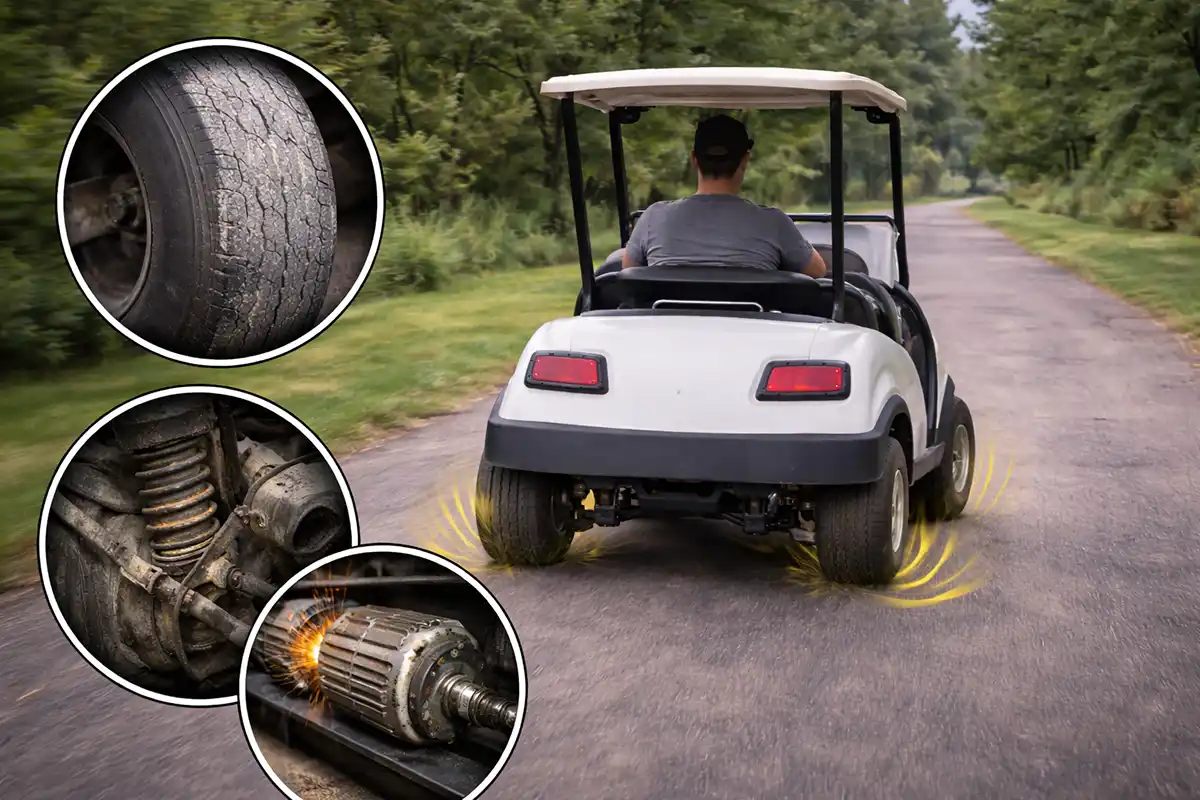
Summary: A golf cart that vibrates or shakes while driving is almost always pointing to a problem in one of three areas: the tires, the suspension, or the motor and drivetrain. Vibration is one of the most useful diagnostic symptoms a cart can produce because its character, when it appears, how severe it is, and where it is felt in the cart, narrows the source considerably before any tools come out. This article covers how to read vibration symptoms, why uneven tire wear is the most commonly overlooked starting point, what suspension components fail and how to identify them, and when motor or drivetrain imbalance is the actual culprit.
Vibration in a moving golf cart is not just uncomfortable, it is communicative. The frequency of the shake, whether it appears only at certain speeds, whether it is felt more in the steering wheel or through the seat, and whether it changes when you turn slightly left or right are all clues that point toward specific failure categories. Owners who treat vibration as a single vague symptom tend to replace parts at random. Owners who treat it as diagnostic data tend to find the cause quickly and inexpensively.
Tire Issues
Tires are responsible for the majority of golf cart vibration complaints, and within that category, uneven wear is the cause that gets overlooked most consistently. A tire that has worn unevenly across its tread width, developed flat spots from sitting stationary for an extended period, or lost significant air pressure on one side will produce a rhythmic vibration that pulses with each wheel revolution. That pulsing quality, vibration that has a beat to it rather than a constant buzz, is one of the clearest indicators that the source is rotational and tire-related.
Flat spotting is particularly common on carts that spend months in storage without being moved. The portion of the tire in contact with the ground deforms slightly under the static weight of the cart, and if temperatures dropped during storage, that deformation can become semi-permanent. In mild cases the tire rounds out after a few minutes of driving and the vibration fades on its own. In more severe cases the flat spot is deep enough that the tire needs replacement to resolve the symptom fully.
Imbalance on Tires
Tire pressure imbalance between the left and right rear tires is another frequent and easily corrected cause. Golf cart tires are typically inflated to between 15 and 25 PSI depending on the size and style, and a difference of even four or five PSI between sides can introduce enough rolling asymmetry to produce a noticeable shake at speed. Check and equalize pressure across all four tires before pursuing any more involved diagnosis. It takes five minutes and resolves the problem more often than the effort suggests it should.
Beyond wear and pressure, a tire that has separated internally, meaning the steel belt or fabric plies have delaminated from the rubber, will produce vibration that does not correlate with speed in a predictable way and often worsens suddenly rather than gradually. An internal separation is visible as a bulge or bubble in the sidewall and represents a safety risk that warrants immediate tire replacement regardless of the remaining tread depth.
Suspension
If the tires check out, the suspension is the next logical area to examine. Golf carts use relatively simple suspension geometry compared to passenger vehicles, but the components that absorb road shock and maintain wheel alignment still wear, loosen, and fail over time. The most common suspension-related sources of vibration are worn leaf spring bushings, loose or damaged shock absorbers, and play in the front spindle or kingpin assembly.
Leaf spring bushings are small rubber or polyurethane inserts that allow the spring to articulate without metal-on-metal contact at its mounting points. When those bushings wear out, the spring moves with a slight clunk or wobble that translates into vibration through the frame, particularly over uneven terrain. Inspecting the bushings requires nothing more than a visual check and a pry bar to check for play at each mounting point. Replacement bushings are inexpensive and the swap is accessible on most cart platforms without specialty tools.
Front end play in the kingpin or spindle assembly produces a steering-related vibration that is often most noticeable when the cart is driven over a bump or rough patch. Gripping the front tire at the 9 and 3 o’clock positions and attempting to rock it back and forth with the cart on a jack will reveal lateral kingpin play. Gripping at 12 and 6 reveals vertical spindle bearing wear. Either type of play should be corrected before it progresses, as worn front end components affect steering precision and tire wear in addition to producing vibration.
Community Insight
“Everyone goes straight to suspension or bearings but nine times out of ten it’s the tires. Uneven wear, a flat spot from sitting all winter, or just one tire low on pressure. Check the tires first every single time.”
Recurring community consensus across Reddit golf cart ownership discussions
Motor and Drivetrain Imbalance
When tires and suspension have been ruled out, the vibration source shifts to the drivetrain. On electric carts, a motor with a worn or damaged bearing produces a vibration that is felt as a steady buzz or hum that is present whenever the motor is running under load and absent when the cart is coasting with the motor disengaged. This is a meaningful distinguishing characteristic, if the vibration disappears the moment you lift off the accelerator and the cart coasts quietly, the motor or its mounting is a strong candidate.
Rear axle bearing wear produces a similar but slightly different symptom. Axle bearing vibration tends to be more directional, felt more strongly through the rear of the seat than through the steering, and it may change character slightly when weight shifts during a turn. Jacking the rear of the cart and spinning each rear wheel by hand while listening and feeling for roughness or grinding will confirm a failing wheel bearing quickly. A bearing that feels smooth when spun slowly but grinds under load is deteriorating internally and will eventually fail completely if not replaced.
On gas carts, a failing drive belt, worn clutch sheaves, or an engine mount that has cracked or separated can all introduce vibration that is felt throughout the cart at driving speeds. Engine mount inspection is straightforward and is worth adding to any vibration diagnostic on a gas platform, particularly on carts that have accumulated significant hours or have been operated frequently on rough terrain.
Related Services:
Frequently Asked Questions
Why does my golf cart vibrate while driving?
The most common causes are uneven or flat-spotted tires, tire pressure imbalance between sides, worn suspension bushings, front end play in the kingpin or spindle, or a failing motor or axle bearing. Reading the character of the vibration, when it appears and where it is felt, narrows the source before any tools come out.
How do I know if my golf cart tires are causing vibration?
Tire-related vibration typically has a rhythmic, pulsing quality that beats with wheel rotation rather than producing a steady buzz. Check for uneven tread wear across the tire width, flat spots on the contact patch from extended storage, pressure differences between sides, and any sidewall bulges that indicate internal separation.
Can low tire pressure cause a golf cart to shake?
Yes. Even a modest pressure difference between the left and right tires on the same axle can introduce enough rolling asymmetry to produce a noticeable vibration. Check and equalize pressure across all four tires as the first diagnostic step, it takes five minutes and resolves the problem more often than expected.
What suspension parts commonly cause golf cart vibration?
Worn leaf spring bushings, loose or deteriorated shock absorbers, and front end play in the kingpin or spindle bearing assembly are the most frequent suspension-related causes. Kingpin and spindle play can be identified by rocking the front tire in both axes while the cart is safely jacked up.
How do I tell if my golf cart motor is causing vibration?
Motor-related vibration is present under load and typically disappears when the cart coasts with the motor disengaged. If lifting off the accelerator makes the vibration stop immediately while the cart continues rolling, the motor or its mounting is a strong candidate. A worn motor bearing will also produce a steady hum or buzz that is distinctly different from the pulsing rhythm of a tire problem.
Is it safe to drive a golf cart that vibrates?
It depends on the source. A mildly flat-spotted tire that is warming out is generally low risk. A tire with a visible sidewall bulge, significant front end play, or a failing wheel bearing represents a more serious safety concern and should be addressed before continuing regular use. When in doubt, a quick inspection before the next ride is always the right call.
Still Need Help? Connect with our Texas Mechanics
Call or Text Golf Cart Service Center: 214-233-5528
Service Areas: Dallas, Fort Worth, Plano, Arlington, Frisco, McKinney, Tyler, Houston, Austin and beyond!
