
Summary: A golf cart that jerks, lurches, or surges during acceleration is telling you something specific about its electrical system. The symptom almost always originates in one of three places: the throttle position sensor sending inconsistent voltage signals, the motor controller misreading those signals or developing internal faults, or worn mechanical components that introduce resistance at unpredictable moments. This article explains how smooth acceleration is supposed to work, what breaks down to produce jerky or surging motion, and the diagnostic steps and fixes that resolve the majority of cases without replacing major components.
Smooth, progressive acceleration is one of the clearest signs that a golf cart’s electrical and mechanical systems are working in harmony. When that smoothness breaks down into jolts, lurches, or inconsistent surges of speed, the cart is generating a useful diagnostic signal — even if it does not feel that way when you are trying to navigate a fairway or a neighborhood street without rattling your passengers. Understanding what produces smooth motion in the first place is the fastest path to understanding what has gone wrong.
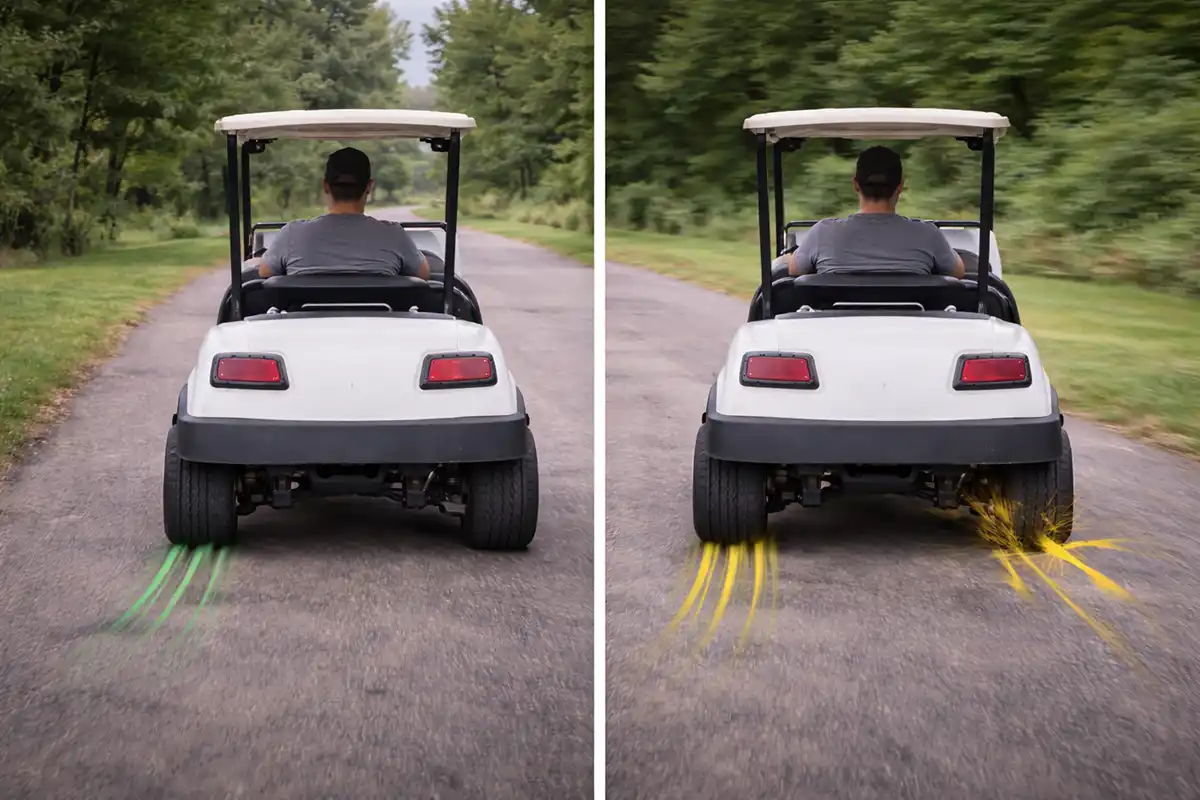
Smooth vs. Jerky Motion
On an electric golf cart, the motor controller is responsible for translating the position of the accelerator pedal into a precisely modulated output of current to the motor. When you press the pedal gradually, the controller reads a rising voltage signal from the throttle sensor and ramps current up proportionally, producing the smooth linear acceleration that makes electric carts feel composed and easy to drive. The entire system depends on a clean, consistent signal chain from the pedal to the sensor to the controller to the motor.
When any part of that chain introduces noise, gaps, or sudden jumps in the signal, the controller responds accordingly. A throttle sensor with worn or dirty internal resistive material may send voltage that jumps erratically even as the pedal moves smoothly. The controller interprets those jumps as rapid changes in pedal position and modulates current accordingly, which is what the driver feels as jerking or surging. The motor itself is doing exactly what it is told. The problem is what it is being told.
On gas-powered carts, the analog is similar but the mechanism differs. A carburetor with a partially clogged jet, a worn governor spring, or a sticking throttle cable can produce surging behavior that closely mimics the electrical version. Identifying whether the cart is electric or gas narrows the diagnostic field significantly, though both platforms share the common thread that inconsistent fuel or current delivery produces inconsistent motion.
Controller Faults
The motor controller processes the throttle signal and converts it into a timed series of electrical pulses that drive the motor at variable speed. When the controller itself develops a fault, the output it delivers can become erratic independent of what the throttle sensor is sending. Controllers can develop internal faults from heat cycling over time, from voltage spikes caused by loose battery connections or a failing solenoid, or from moisture intrusion in carts stored outdoors without adequate cover.
A controller fault does not always mean a dead controller. Many intermittent controller faults manifest as surging or jerking rather than a complete no-go condition, because the internal components are still functional enough to operate but not stable enough to modulate current cleanly. Programmable controllers from manufacturers like Curtis or Alltrax store fault codes that can be read with a handheld programmer or a compatible app, giving a direct read on whether the controller is logging overcurrent, throttle faults, or temperature-related events. For carts with non-programmable OEM controllers, the absence of fault codes means diagnosis relies more heavily on observation and voltage testing.
Loose or corroded battery connections are a frequently overlooked contributor to controller instability. A pack connection that introduces variable resistance under load causes the controller’s supply voltage to fluctuate, which can produce surging behavior that looks like a controller or throttle fault. Before replacing any major component, inspect and clean every battery terminal and cable connection in the pack. It is one of the lowest cost and highest return diagnostic steps available.
Throttle Sensor Issues
The throttle position sensor, sometimes called an inductive throttle sensor (ITS) on EZGO models or a potentiometer-style sensor on older Club Car and Yamaha platforms, is a high-wear component that degrades gradually with use. The resistive track inside a potentiometer-style sensor develops flat spots or worn areas over time, and when the pedal sweeps across one of those worn zones, the voltage output drops or spikes unexpectedly. The controller reads that as a sudden change in pedal position and responds with a corresponding change in motor output.
Diagnosing a throttle sensor requires a multimeter and basic access to the sensor connector. With the key on and the sensor unplugged, verify that the sensor is receiving the correct supply voltage from the controller harness, typically 5 volts on most modern systems. Then reconnect the sensor and measure the output voltage while slowly pressing the accelerator pedal by hand. The output voltage should rise smoothly and linearly from a low value at rest to a high value at full pedal. Any sudden jump, drop, or flat spot in that sweep confirms a worn or failing sensor. Replacement sensors are widely available for all major cart platforms and are typically a straightforward swap that resolves the symptom entirely when the sensor is the actual cause.
Forum Insight
“Throttle sensors are almost always the first thing to check on a surging cart. The potentiometer wears in specific spots and sends garbage signals to the controller. Swap the sensor before you ever touch the controller.”
Community insight via Cartaholics
Fixes
Begin with the least invasive steps and work toward the more involved ones. Clean and retorque every battery terminal and cable end in the pack. Inspect the throttle sensor connector for corrosion or loose pins and test the sensor sweep with a multimeter as described above. If the sensor sweep is not clean and linear, replace the sensor before spending any time on the controller. On EZGO TXT and RXV models, ITS replacement is a 30-minute job with basic tools. On Club Car DS and Precedent models, the potentiometer is accessible under the front cowl with similar ease.
If the sensor tests clean and the surging persists, read the controller for stored fault codes if the platform supports it. Codes pointing to overcurrent, supply voltage fluctuation, or throttle signal errors will direct you precisely. If no codes are present and the controller is more than eight to ten years old with documented heat exposure or moisture history, a controller replacement is a reasonable conclusion after the sensor and battery connections have been ruled out. Replacing the sensor first is not just a logical sequence, it is also the sequence that saves the most money in the majority of cases.
Frequently Asked Questions
Why does my golf cart jerk when I accelerate?
Jerky acceleration on an electric golf cart is almost always caused by an inconsistent signal reaching the motor controller. The most common sources are a worn throttle position sensor sending erratic voltage, loose or corroded battery connections causing supply voltage fluctuation, or an internally faulted controller. Diagnosing the throttle sensor first is the most efficient starting point.
What causes a golf cart to surge at constant speed?
Surging at a steady pedal position often points to a throttle sensor with a worn spot in the resistive track, which causes the output voltage to oscillate even when the pedal is held still. It can also indicate a controller that is logging temperature or voltage faults and intermittently reducing output as a protective response.
How do I test a golf cart throttle sensor?
With the key on, measure the output voltage at the sensor connector while slowly pressing the accelerator pedal from rest to full position. The voltage should rise smoothly and continuously with no jumps, drops, or flat spots. Any irregularity in that sweep indicates a worn or failing sensor that should be replaced.
Can loose battery connections cause a golf cart to surge?
Yes, and this is one of the most frequently missed causes. A connection with variable resistance under load causes the controller’s supply voltage to fluctuate, which produces erratic current output to the motor. Inspecting and cleaning every battery terminal and cable end is a zero-cost diagnostic step that resolves surging in more cases than most owners expect.
Is a jerking golf cart a sign of controller failure?
It can be, but controller failure is a less common cause than a worn throttle sensor or poor battery connections. Controllers do develop internal faults that produce surging, particularly in older units with heat or moisture exposure, but replacing a controller before testing the sensor and connections first is an expensive and often unnecessary step.
How much does it cost to fix a surging golf cart?
If the throttle sensor is the cause, the part costs between $20 and $80 depending on the cart model and a replacement takes under an hour. Battery terminal cleaning costs nothing. A controller replacement, if ultimately needed, typically runs between $200 and $600 for the unit depending on the platform, plus labor if the work is done professionally.
Still Need Help? Connect with our Texas Mechanics
Call or Text Golf Cart Service Center: 214-233-5528
Service Areas: Dallas, Fort Worth, Plano, Arlington, Frisco, McKinney, Tyler, Houston, Austin and beyond!
