
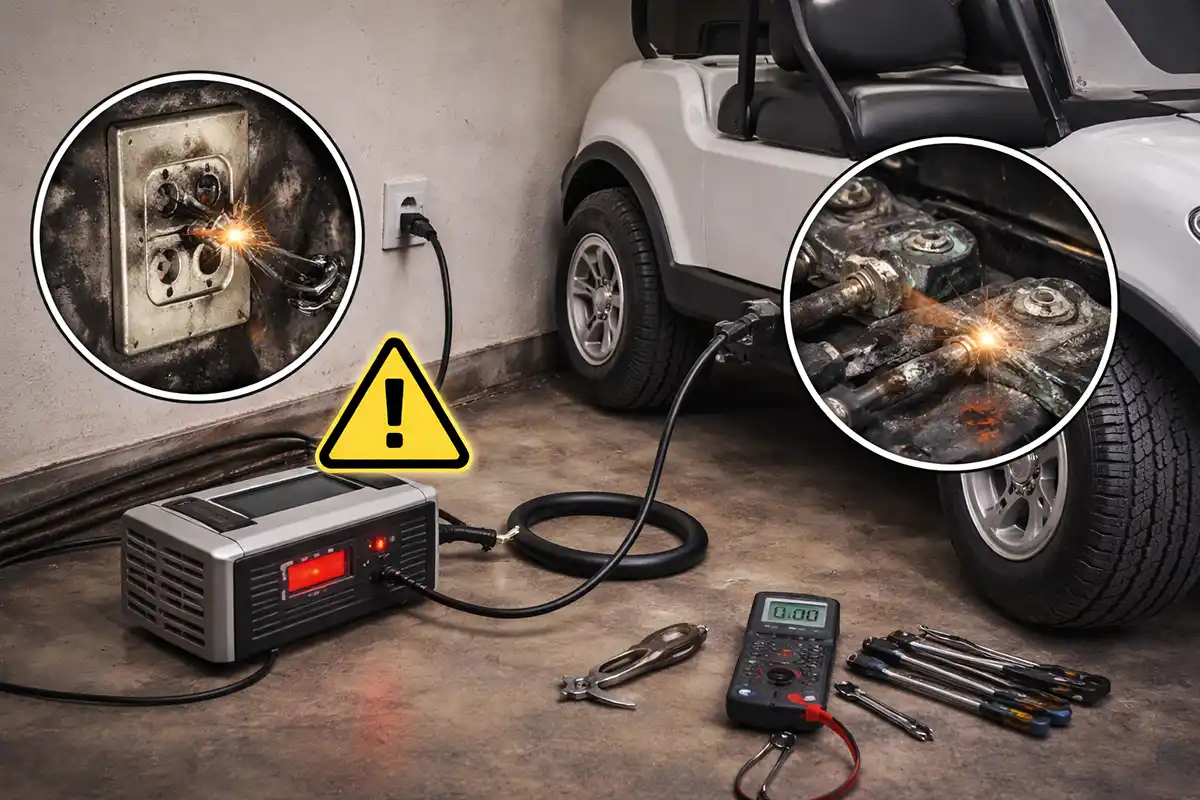
Summary: A golf cart charger that refuses to turn on or fails to complete a charge cycle is one of the most frustrating ownership problems because the cause is rarely obvious from the outside. This article walks through how golf cart chargers actually work, how to distinguish a dead outlet from a dead charger, why a low or deeply discharged battery pack can prevent the charger from initiating at all, and the step-by-step fixes that cover the majority of charging failures without requiring a replacement unit. Most charging problems are solvable without buying a new charger, the key is knowing where to look first.
You plug in at the end of the day, walk away, and come back to find the charger fan never ran and the charge indicator never moved. The cart just sat there all night on a dead pack. Charging failures are among the most common service calls in the golf cart world, and they also produce some of the most misdiagnosed outcomes, owners replace chargers that were working fine, or replace batteries that were not actually the problem. A systematic approach to diagnosis changes that entirely.
How Golf Cart Chargers Work
Understanding the basics of how a charger initiates a charge cycle makes the diagnostic process considerably more logical. Most modern golf cart chargers, whether original equipment or aftermarket, use an automatic charging profile that starts by sensing the voltage present at the battery pack through the charge port. The charger uses that initial voltage reading to confirm that a compatible battery pack is connected before it begins delivering current. This is a protective feature, not a flaw, but it is the exact reason why a charger that appears completely dead is not always a failed charger.
On older Powerwise-style chargers commonly found on EZGO carts, the charge circuit uses a separate DC plug that draws a small amount of power directly from the battery pack to wake the charger up. If that circuit is broken or the pack is too low, the charger has no way to power itself on and will appear completely inoperative. Delta-Q chargers, common on newer Club Car and Yamaha models, use a similar sense voltage requirement but communicate via a more sophisticated algorithm that can display fault codes if the pack voltage falls outside its expected range.
Outlet vs. Charger Failure
Before concluding that the charger itself has failed, rule out the power source completely. This sounds obvious but is frequently skipped. Plug a lamp or another device into the same outlet and confirm it powers on. Check the circuit breaker for that outlet and reset it if it has tripped. If the outlet is on a GFCI circuit, check the GFCI reset button, which is often located on a different outlet in the same circuit rather than the one you are using. Outdoor outlets and garage circuits are frequently GFCI-protected, and a tripped GFCI with no visible indicator light is a surprisingly common source of charging failures that get blamed on the charger.
If the outlet is confirmed live and the charger still shows no activity, inspect the charge port on the cart and the charger plug itself. Bent or corroded pins in the charge receptacle are common on carts that live outdoors, and a connection that looks intact may not be making solid electrical contact. Clean the pins with a contact cleaner and inspect for any pin that is recessed or bent out of alignment. A multimeter set to DC voltage can confirm whether the charger is outputting any voltage at the plug, which isolates the fault to the charger unit itself if the outlet and receptacle are both in good condition.
Battery Lockout: When the Pack Prevents Charging
This is the diagnostic category that catches most people off guard. A battery pack that has been deeply discharged, meaning individual cells have dropped below a threshold the charger considers safe, will cause many automatic chargers to refuse to initiate. The charger senses a voltage so low that it falls outside its expected range for a connected pack and interprets the situation as either no pack present or a potentially damaged pack. It does nothing, which looks exactly like a failed charger.
On a standard 48-volt lead acid system, most automatic chargers expect to see at least 35 to 40 volts at the pack before they will begin. A pack that has dropped below that threshold needs to be manually brought up, sometimes called a bulk charge, using a separate DC power source or a charger specifically capable of recovering deeply discharged batteries. Some technicians use a 12-volt automotive battery charger connected across individual batteries in the pack in sequence to bring each one up enough for the main charger to recognize the pack and take over.
Lithium packs with an integrated BMS add another layer to this scenario. If the BMS has tripped a protection fault due to deep discharge, cell imbalance, or overtemperature, it may disable the charge port entirely until the fault is cleared. Connecting a compatible diagnostic tool or Bluetooth app to the pack is the only way to read and clear those faults, and attempting to force-charge a lithium pack with a faulted BMS is not a viable workaround.
Forum Insight
“Nine times out of ten when a charger appears completely dead, the battery pack voltage has dropped too low for the charger to recognize it. Check your pack voltage with a meter before assuming the charger is gone.”
Community insight via BuggiesGoneWild
Fixes
Work through the diagnosis in order of simplicity. Confirm the outlet is live, inspect and clean the charge receptacle, then measure pack voltage before assuming the charger has failed. If pack voltage is below the charger’s initiation threshold, use a manual bulk charge method to bring the pack up, then reconnect the automatic charger and allow it to complete a full cycle. If the charger still does not initiate after pack voltage is confirmed within range, test the charger output with a multimeter. No output voltage from a live outlet with a properly connected pack points clearly to a failed internal component, at which point repair or replacement is warranted depending on the charger model and age.
For EZGO Powerwise chargers, the DC receptacle circuit is a common failure point and is repairable without replacing the entire unit. For Delta-Q chargers, fault codes displayed on the LED indicator correspond to specific diagnoses in the manufacturer’s documentation, and many faults are recoverable through a reset procedure. Replacing a charger outright before exhausting these steps is one of the most common and avoidable expenses in golf cart ownership.
Related Service: Golf Cart Battery Upgrade and Replacement Service
Frequently Asked Questions
Why won’t my golf cart charger turn on?
The most common reasons are a tripped outlet or GFCI breaker, a corroded or damaged charge receptacle, or a battery pack voltage that has dropped too low for the charger to recognize. Rule out each of those before concluding the charger itself has failed.
How low does battery voltage have to be before a charger won’t initiate?
On most 48-volt automatic chargers, the initiation threshold is somewhere between 35 and 40 volts. Below that, the charger interprets the pack as disconnected or damaged and will not begin a charge cycle. A manual bulk charge is needed to bring the pack back into the charger’s acceptable input range.
Can a bad battery cause a golf cart charger to stop working?
Yes. A single failed battery in the pack can drag total pack voltage below the charger’s initiation threshold, or it can create a voltage imbalance that prevents the charger from completing its cycle. Testing each individual battery with a multimeter or load tester is the only way to identify the weak cell in the bank.
What does it mean when my Delta-Q charger shows a flashing fault code?
Delta-Q chargers use LED blink patterns to communicate specific fault states. A single blink typically indicates a battery voltage fault, while multiple blinks correspond to different internal or pack-side issues. The full fault code reference is available in Delta-Q’s published documentation and is worth consulting before assuming the charger unit needs replacement.
How do I know if my golf cart charger is actually bad?
After confirming the outlet is live and the battery pack is within the charger’s initiation voltage range, use a multimeter to test for output voltage at the charger plug. If the outlet is good, the pack voltage is in range, the receptacle pins are clean and intact, and the charger still produces no output voltage, the internal components of the charger have most likely failed.
Is it worth repairing a golf cart charger or should I just replace it?
It depends on the charger model and the failure point. Older Powerwise units are often repairable at low cost if the DC receptacle circuit is the only fault. Newer Delta-Q or OBC units may be worth repairing if they are relatively new. For chargers that are more than eight to ten years old with multiple fault conditions, replacement is usually the more economical long-term choice.
Still Need Help? Connect with our Texas Mechanics
Call or Text Golf Cart Service Center: 214-233-5528
Service Areas: Dallas, Fort Worth, Plano, Arlington, Frisco, McKinney, Tyler, Houston, Austin and beyond!
